
Every review of a chimney starter says the same three things. No lighter fluid taste, coals ready in under fifteen minutes, cheap enough not to think about. All true. None of it is what actually surprised me about the Weber Rapidfire once I'd been running it hard for a while. I already wrote up the long-term durability side of owning this thing, the two years, the roughly 180 lights, the wood handle that hasn't split. This one's different. This is the stuff that doesn't show up in the marketing copy or in most reviews, the parts that only show up once you've grabbed the handle at the wrong moment, lit it in a bad wind, or run your fingers along the seam near the base and felt something you didn't expect.
I'm Wes, I grill in Albuquerque at about 5,000 feet, and I've had a Weber chimney in rotation long enough to have opinions that go past the first cookout. Some of what people assume about this tool is right. Some of it isn't, and a couple of the things nobody mentions before you buy are exactly the things that would've changed how I used it from day one if someone had just said them out loud.
The Quick Verdict
It lights charcoal fast and honestly, but the handle gets hotter than the marketing suggests, wind costs you real minutes, and there's a rust spot forming at the base seam that nobody warns you about. Still my pick, with clearer eyes than the first review.
Amazon Check Today's Price →Before You Buy One, Here's What the Box Doesn't Tell You
The Weber Rapidfire is a genuinely good chimney starter. It's also got a couple of real quirks nobody mentions until you own one. I'll walk through both below, then you can decide.
Amazon Check Today's Price on Amazon →How I Actually Test a Piece of Gear Like This
I don't test gear by reading the packaging and taking one photo. I test it by using it wrong sometimes, on purpose, and seeing what breaks or what surprises me. With the Weber chimney that meant lighting it in wind I normally wouldn't grill in, grabbing the handle earlier than I should to see how hot is too hot, running it with a bare quarter load to see if a Weber built for a full stack of briquettes actually behaves on a small cook, and finally, after about a year and a half, taking a flashlight to the seams and vents to look for the kind of corrosion that doesn't show up from three feet away.
None of that is standard for a chimney starter review, but a $25 tool that touches fire every single time you grill deserves more than a glance. I also asked two other people who own the same Weber Rapidfire, a coworker in Rio Rancho and a guy I know from the farmers market who smokes ribs most weekends, what surprised them about it. Their answers lined up with mine closer than I expected, which told me these weren't just my own quirks.
What follows isn't a repeat of specs you can read on the listing. It's the stuff that only shows up once you've used the thing enough to stop being careful with it.
The Handle Runs Hotter Than the Reviews Let On
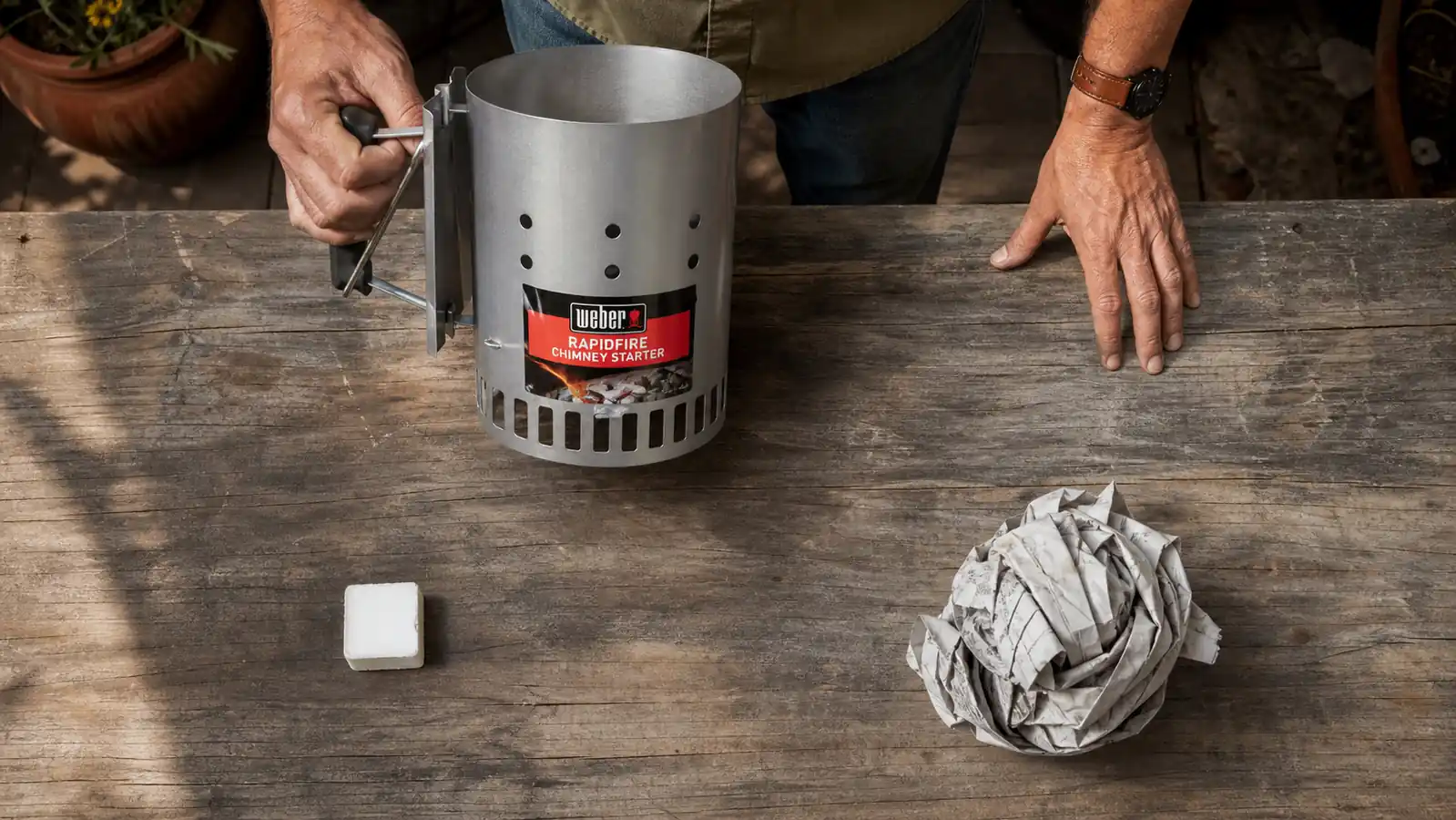
Here's the claim you'll see repeated in a lot of chimney starter writeups. Wood handle, stays cool, safe to grab bare-handed. That's true if you're grabbing it before you light anything, or maybe in the first two or three minutes after the coals catch. It stops being true by the time a full load is fully ashed over and you're ready to dump it.
I tested this directly one Saturday in June. Loaded the Weber full, timed it, and at the 13-minute mark when the top coals were gray, I pressed the back of my hand flat against the wood for a full three count instead of grabbing and immediately releasing the way I normally would. Uncomfortable. Not burn-worthy, but uncomfortable enough that I understood why my coworker in Rio Rancho told me he keeps a folded dish towel wrapped around the handle for anything past a half load. That's not in the instructions Weber ships with the thing, and it's not something the glowing five-star reviews mention, because most people grab, tip, and let go in under two seconds, which genuinely doesn't hurt. It's the pause, the moment you're navigating around a kid's bike left in the yard or a screen door that doesn't want to open, that turns fine into a problem.
My fix has been simple. I clear my path to the kettle before I ever light the newspaper, not after. Takes ten seconds and it means I'm never standing there holding a hot Weber chimney figuring out where to walk.
Wind Costs You More Time Than the Listing Photos Suggest
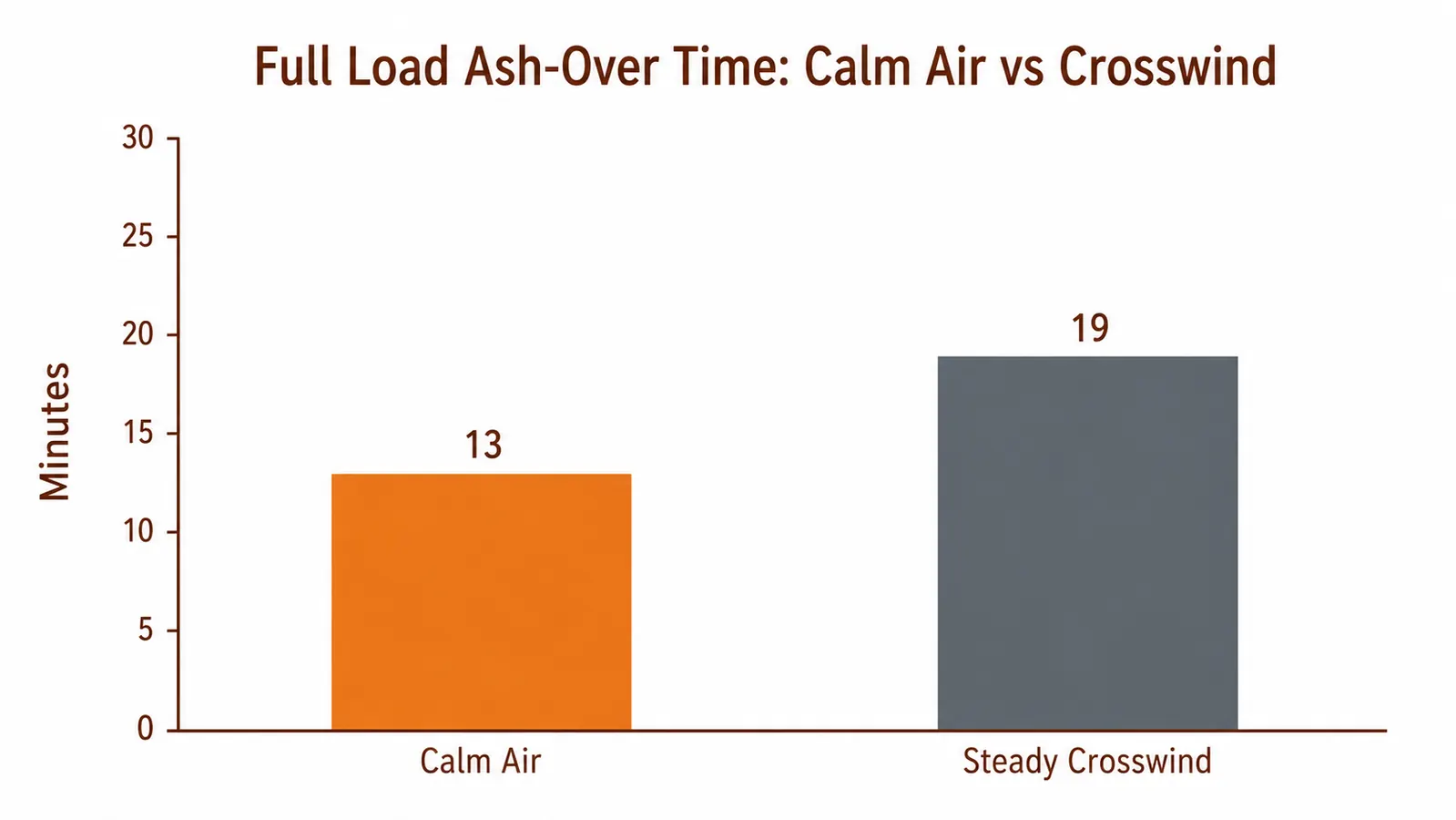
Every product photo of a chimney starter shows it lit on a still day, flame climbing straight up through the vents like a candle. My patio backs up to open ground on the west side, and most spring evenings I've got a steady crosswind coming through, nothing dramatic, just enough to bend a flame sideways. I ran the same test three separate times this spring, full load, same brand of briquettes, same amount of newspaper, once in calm air and twice in that crosswind.
Calm air, the Weber Rapidfire hit full ash-over in 13 minutes, which lines up with what I've reported before. In the crosswind, without a wind guard, it took 19 minutes both times, a full six minutes slower, and the ash-over was uneven, with the windward side catching later than the rest of the stack. Nobody puts that number on the box. The tall, narrow shape that makes this thing work so well in calm air is the same shape that catches a crosswind broadside, because there's a lot of exposed vertical surface for moving air to push against.
A cheap wind guard fixes most of it, and once I started using one, my windy-day times came back down close to the calm-air number. But if you live somewhere with reliable afternoon wind and you don't already own a guard, budget for one at the same time you buy the chimney. Treat it as part of the purchase, not an optional accessory you'll get around to eventually.
Newspaper Versus Cubes, and Why I Stopped Defending Newspaper
I used to be a newspaper purist about this. Free, always on hand, works fine most of the time. I ran a side-by-side comparison this year that changed my mind more than I expected. Same Weber chimney, same load of briquettes, alternating five lights with two sheets of loosely crumpled newspaper and five lights with a single paraffin starter cube.
The newspaper lights averaged 13 minutes to full ash-over but had real variance, one as fast as 11 minutes, one as slow as 16 when I'd packed the paper a little tight without noticing. The cube lights were far more consistent, all five landing between 12 and 13 minutes, no outliers. The cube also doesn't care about humidity or how tightly you happened to crumple things that day, and it doesn't leave ash flakes blowing across the patio the way spent newsprint does on a breezy evening. Newspaper is still free and I still keep some around for a backup, but if you're buying this Weber chimney and want the most predictable lightoff, starter cubes are worth the few extra cents. That's a bigger change of opinion than I expected to make after using this thing for as long as I have.
Capacity Versus What You Actually Need
The Weber Rapidfire is sized to hold close to a hundred regular briquettes at a full load, and most of the marketing leans on that number because it sounds generous. Here's what nobody tells you: most weeknight cooks don't need anywhere near that. A couple of bone-in chicken thighs or a few burgers on a kettle only calls for maybe a quarter to a third of a full load, and running this chimney at quarter capacity is genuinely different from running it full.
A quarter load ashes over fast, often under 8 minutes, but it's also less forgiving of loose packing since there's less mass holding heat and momentum through the stack. I've had a couple of quarter loads stall out halfway, gray on the bottom two inches and stubbornly black on top, because I loaded it the same loose way I would a full stack. The fix is to pack a small load a little denser than you'd think, almost snug, rather than loose the way Weber's own instructions describe for a full chimney. Buying this expecting the big number on the specs sheet to be your everyday reality is where a lot of people set expectations wrong. Most nights, you're using a third of what this thing can hold, and that changes how you should load it.
The Rust Nobody Mentions, at the Seam, Not the Body
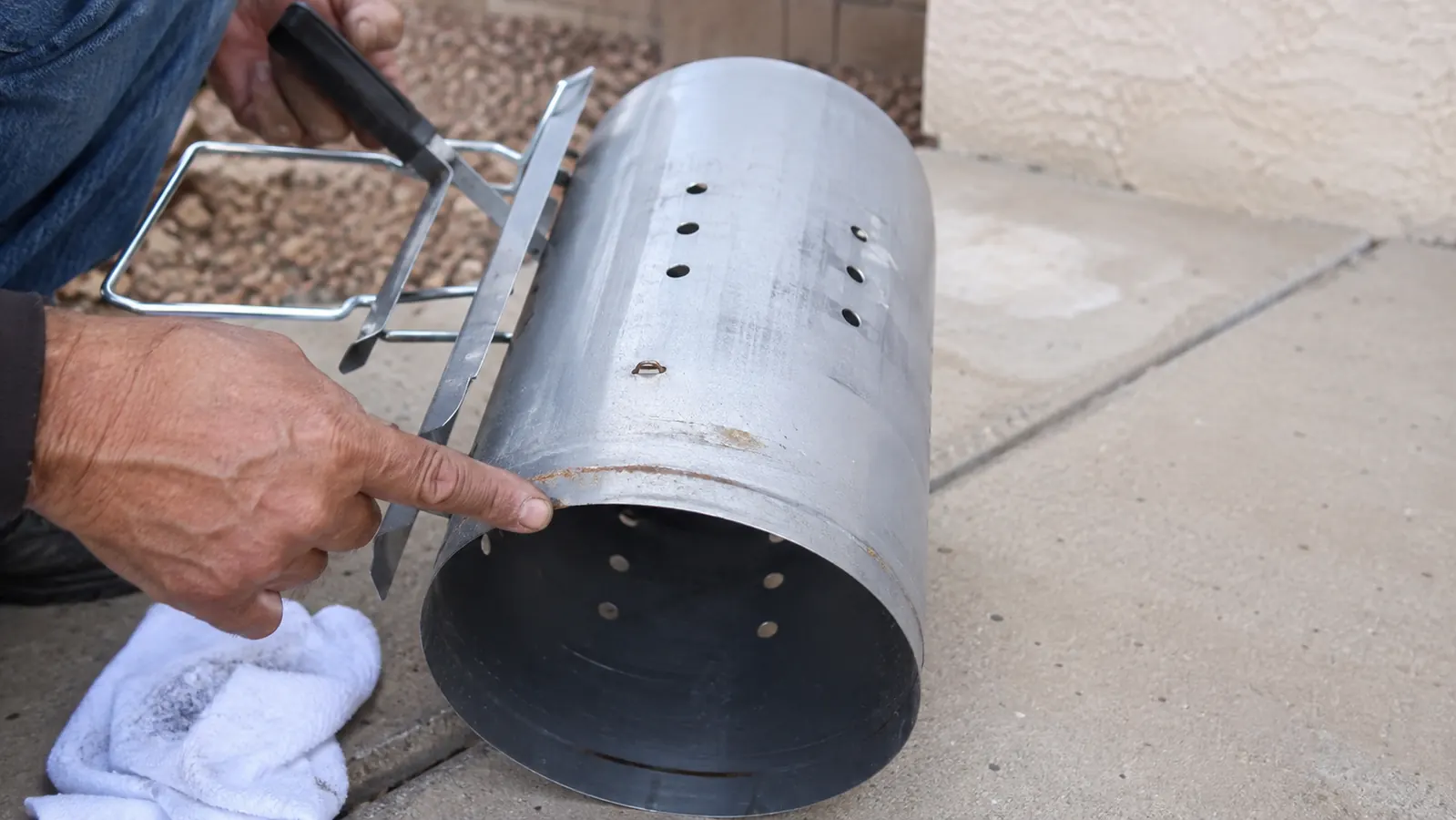
Most reviews, including my own long-term one, talk about the body of the chimney holding up against rust, and that's accurate, the flat galvanized panels resist corrosion well. What I hadn't looked closely at until recently is the rolled seam near the base, where the sheet metal is bent and joined to form the cylinder. That seam gets less zinc coating than the flat faces because of how the metal is formed and rolled, and after roughly a year and a half of outdoor storage under a patio cover, mine has a faint reddish line running along about four inches of that seam.
It hasn't spread, it hasn't affected function, and a light coat of high-heat paint or even regular wipe-downs seems to have kept it from getting worse since I noticed it. But it's real, it's on my unit, and the coworker in Rio Rancho found the same faint line on his when I asked him to check after I found mine. If you store your chimney outside year-round the way I do, check that seam once a season. It's the one spot on this Weber that the galvanizing doesn't fully protect, and nobody puts that in a five-star review.
What I Liked
- Genuinely fast, predictable ash-over once you know how to load it for the size of cook you're actually doing
- Starter cubes make lightoff far more consistent than newspaper, once you're willing to spend the extra few cents
- Wood handle takes real heat without cracking, it just runs hotter than most reviews admit past the first few minutes
- Galvanized body resists rust well on the flat panels even after well over a year outside
- Cheap enough that a wind guard and a bag of starter cubes on top of it still costs less than most other grill accessories
Where It Falls Short
- Handle gets uncomfortably warm if you hesitate before dumping a full load, not dangerous but worth planning your path first
- A steady crosswind can add 5 to 6 minutes to ash-over time without a wind guard
- The rolled seam near the base is thinner on zinc coating and can show faint rust after long-term outdoor storage
- Quarter loads need denser packing than the instructions suggest or they stall out unevenly
- No second handle or any heat shield, so it's entirely on you to manage grip and timing on a full load
The listing photo shows a still day and a straight flame. My patio doesn't have still days, and that gap between the photo and the real backyard is where most of these lessons came from.
Who This Is For
This is for someone who's already decided a chimney starter beats lighter fluid and just wants the honest version of what owning one is actually like, quirks included. If you're the type who reads the fine print and would rather know about handle heat and wind loss before you're standing on the patio figuring it out yourself, this is exactly the kind of buyer this Weber rewards. It's also a solid pick if you cook variable-sized loads, weeknight quarter loads and weekend full loads both, since once you understand the loading difference between the two, the Weber handles both well.
Who Should Skip It
If you live somewhere with consistent strong wind and you're not willing to also buy a guard, you'll spend more time frustrated with slow, uneven lightoffs than the reviews suggest, and that's on the environment more than the tool. Skip it too if a warm handle on a full load is a real dealbreaker for you rather than a minor annoyance, since no amount of technique fully eliminates that. And if you're only ever cooking small quarter loads and don't want to think about packing density differently than a full stack, a smaller charcoal starter basket built for lower volume might suit you better than this Weber's full-size capacity.
Know the Quirks, Still Worth Buying
Hot handle on a hesitation, wind that costs real minutes, a seam that needs an occasional check. None of it changes my answer. The Weber Rapidfire is still what I reach for, now with eyes wide open about what the listing doesn't mention.
Amazon Check Today's Price on Amazon →