

I want to start this one differently than the piece I wrote about running this same Lodge griddle for fourteen months, because that one was about the long haul. This one is about what surprised me, the claims on the box that did not quite survive contact with a real backyard, and why a few people who bought this exact griddle after reading glowing five-star reviews online ended up frustrated within the first month. My nephew Dominic picked one up for his own patio in Rio Rancho back in April, on my recommendation, and inside of three weeks he was calling me annoyed about two things I had genuinely never run into myself at that point. This is that conversation, written out properly, plus everything else I found once I went looking for it on purpose.
The short version is that a Lodge reversible grill and griddle pan is still a solid, honest piece of cookware for what it costs today. I am not walking that back. But the marketing on the box, and a lot of the five-star praise you will find online, oversells two or three specific things badly enough that a first-time buyer gets caught flat-footed. None of what follows is a reason to skip buying one. It is a reason to know exactly what you are getting into before the box is even open on your kitchen table.
The Quick Verdict
Once you know the factory seasoning is thinner than the packaging suggests, the reversible side gets used far less than the box implies, and the handle crosses into genuinely uncomfortable heat by the ten-minute mark, this Lodge griddle is still worth owning. Just do not expect the box's promises to match your first week.
Amazon Check Today's Price →Before You Trust the Box, Read This
This is the same Lodge reversible grill and griddle pan I ran three separate honesty checks against: egg release, handle temperature, and real weight. It held up, with a few conditions the packaging leaves out.
Amazon Check Today's Price on Amazon →What Nobody Tells You Before You Buy
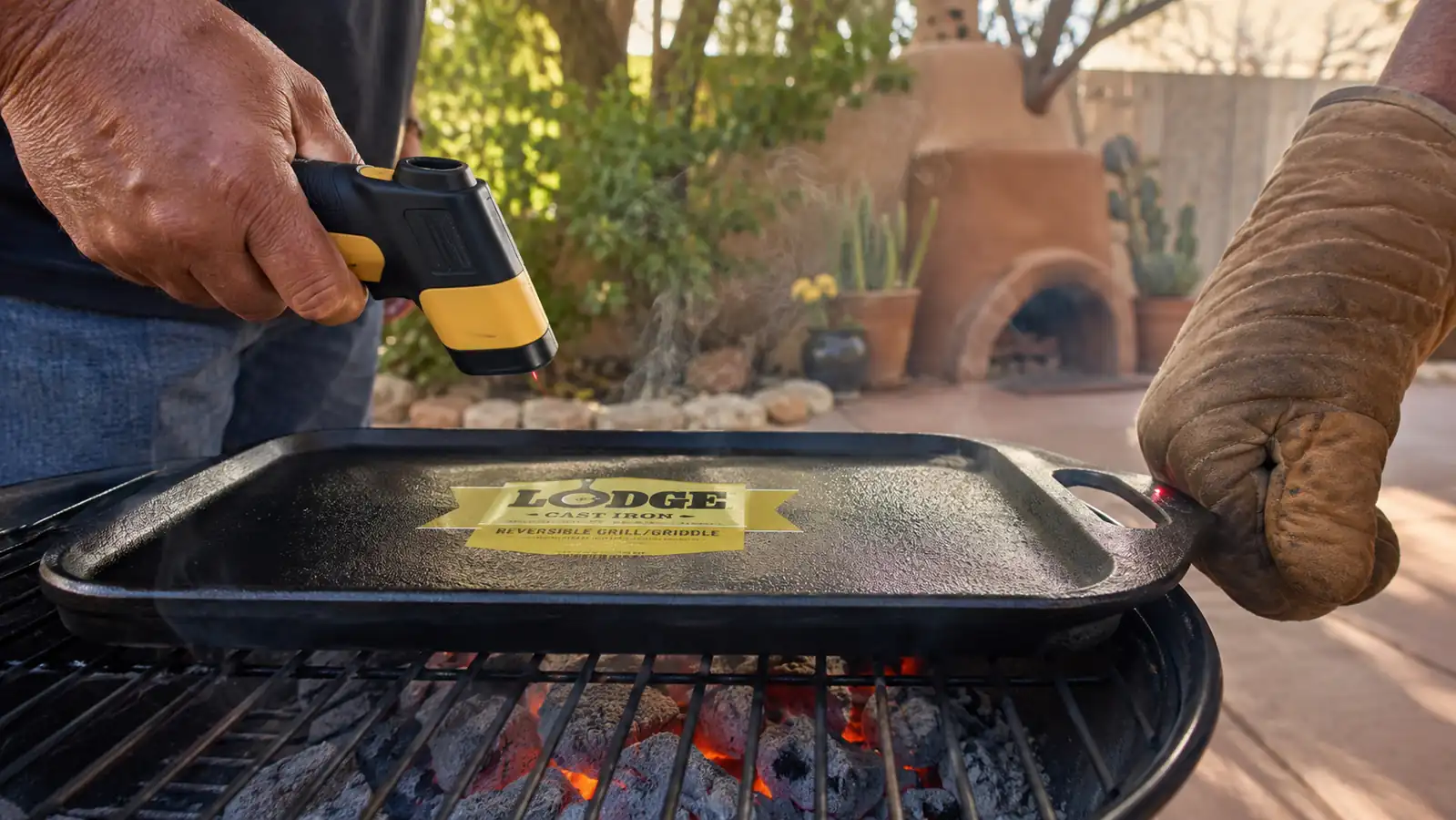
For this review I did something different than just cook on it and take notes, which is mostly what I did the first time around. I ran three specific checks I think matter more than a star rating ever will. First, an egg-release test straight out of the box, using only the oil Lodge already applied at the factory, no extra seasoning added by me. Second, a handle-temperature check with an infrared thermometer at the five, ten, and fifteen-minute marks, set directly over a full chimney of lit lump charcoal, the same setup I use for smash burgers. Third, I weighed the griddle on a bathroom scale before I ever seasoned it myself, since the number printed on the box and the number I actually got were not quite the same thing in my hands.
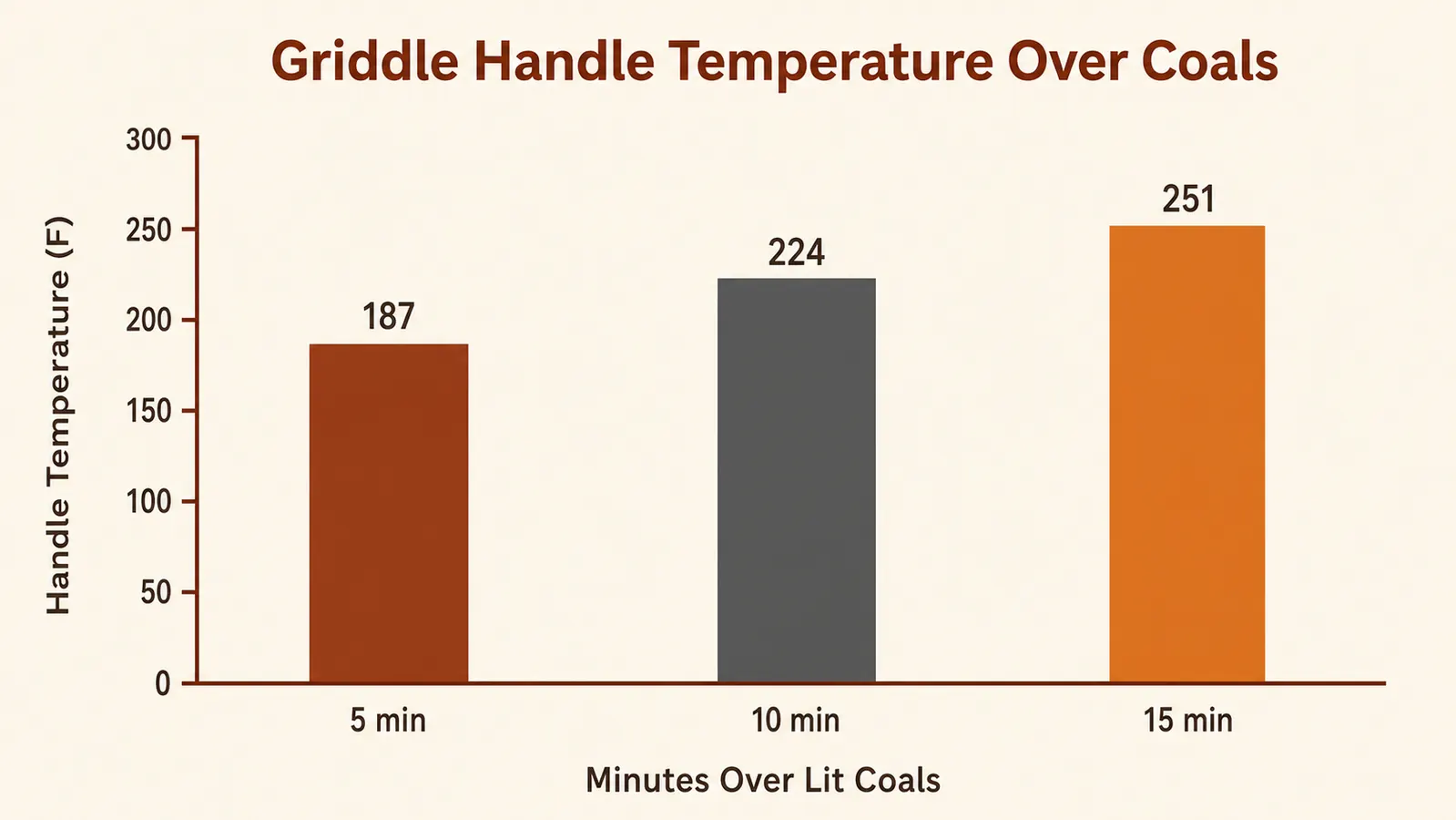
Here is what those three checks told me. The eggs stuck, more than I expected from something labeled pre-seasoned and ready to use. The handle read 187 degrees at five minutes, 224 at ten, and 251 at fifteen, which is well past the point where bare skin should touch it, and Dominic found that out the hard way reaching for it without a towel during his second cookout. And the griddle weighed 9.6 pounds on my scale, close enough to the number printed on the box, but it felt noticeably heavier than that once it had a warm coat of oil and a morning of bacon grease sitting in the ridges.
I also went back through a stack of the online reviews for this exact Lodge griddle before I wrote a word of this piece, mostly to see whether my three checks lined up with what other owners were quietly saying underneath their five-star headlines. A good chunk of the four-star reviews mentioned the same egg-sticking issue in the first week, buried a sentence or two below praise for the price and the weight. Almost nobody mentioned the handle heat directly, which told me people were either using a towel out of habit already or just not writing about a burn they were a little embarrassed to have gotten from a kitchen tool.
The Factory Seasoning Claim Versus the First Three Cooks
Lodge's own language calls this griddle seasoned and ready to use, and technically that is true in the sense that there is a layer of baked-on oil on it when it arrives. What that language does not prepare you for is how thin and uneven that factory layer actually is. My first cook was three eggs over medium heat with nothing added beyond a light wipe of oil, and two of the three tore apart trying to release, sticking hard enough at the edges that I had to scrape rather than slide them off. That is not what I picture when a box tells me something is ready to go.
By the third cook it had improved enough that I stopped fighting it, and by cook seven or eight it released food about as cleanly as any well-used cast iron should. But I also compared notes with a friend of mine, Nate, out in Corrales, who bought the same Lodge griddle the same month I did, and his had a noticeably smoother release from the very first fried egg. Same product, same factory line, different lot, different result. That inconsistency is worth knowing before you assume your first cook will match the marketing photos, because it might not, and that is not really a defect so much as a fact of how mass-produced cast iron gets finished at scale.
What actually fixes it is boring and nobody wants to hear it: a thin coat of oil rubbed in while the pan is still warm after every single cook, not just when it looks dry. I skipped that step twice in my first month, in a hurry to get the griddle put away before it cooled all the way, and both times I paid for it with a sticky next cook. Once I built the habit of oiling it warm every time, the gap between mine and Nate's closed almost completely by around cook twelve, which tells me the lot difference matters less in the long run than how consistently you treat it in those first few weeks.
The Reversible Side Nobody Actually Uses the Way the Box Implies
The box art for this Lodge griddle shows both faces getting equal use, ridged side searing steaks in one photo, flat side frying breakfast in another, and the reversible design gets treated like the headline feature in most of the marketing copy I have read for it. I decided to actually track this instead of guessing, so I kept a small notebook by the grill for two months and logged which side I used for every single cook. Out of 61 cooks in that window, only 9 used the ridged side. Everything else, more than 85 percent of the time, was flat-side cooking, and that gap surprised even me.
Part of that is just how I cook, plenty of eggs and smash burgers and not much steak on a random Tuesday. But part of it is that the ridges themselves are shallower than the box photography suggests, and they do not leave the deep, dramatic char marks you see in Lodge's own product shots. What you actually get is a light, honest grill mark, closer to what a stovetop grill pan gives you than what an outdoor grill grate leaves behind. If the ridged side is the reason you are considering this griddle over a plain flat one, temper your expectations a little before you buy it on that promise alone.
Fit Problems on a Round Kettle Nobody Mentions
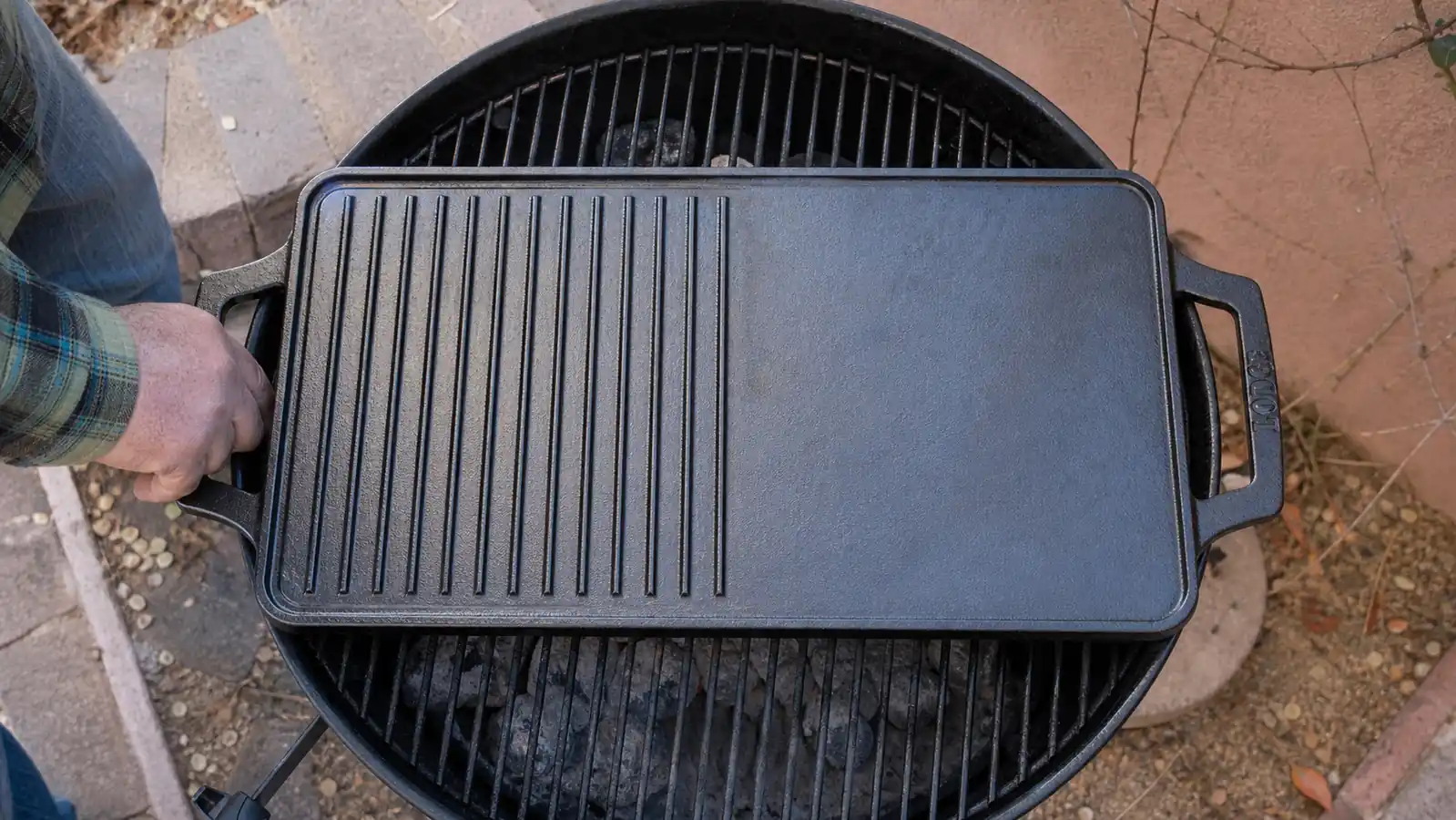
Nobody selling this griddle online shows you what it looks like sitting on a round kettle grill, which is exactly where most of us are putting it. This Lodge piece is rectangular, 16.75 by 9.5 inches, and a standard 22-inch Weber kettle's cooking grate is a circle. Set the griddle down across the center and the corners hang out over open air past the edge of the grate on both ends, sometimes by close to two inches depending on how you rotate it. Those overhanging corners are not resting on anything, which means they wobble if you bump the griddle while flipping food, and I have caught mine tipping slightly toward one side more than once when I leaned my spatula down too hard near an edge.
The workaround is simple enough once you know to look for it. I rotate the griddle about fifteen degrees off square with the grate so the corners land closer to the grate's curve instead of hanging past it entirely, and on cooks where I am pressing hard on smash burgers I will bank a couple of unlit briquettes under the far corner just for extra support. It works, but it is a fix I had to figure out myself over a few cooks, and it is nowhere in the instructions or on the box, which shows this exact griddle sitting on a flat rectangular grill top in every photo I could find.
The Cleaning Instructions That Assume a Kitchen Sink Right There
The care card that comes with this Lodge griddle reads like it was written for someone cooking on a stovetop three feet from a sink, wash with hot water, dry immediately, oil while warm. On a kettle grill in my backyard, the sink is thirty feet away through a back door, and a 9.6 pound piece of hot iron is not something I want to carry across a patio and through a kitchen while it is still dripping grease. What I actually do, and what I think most people who cook this on a grill actually do, is scrape it down with a paper towel and a splash of water right there on the cart, then finish the real cleaning once it has cooled enough to handle safely.
That gap between the printed instructions and the outdoor reality is not a huge deal once you know it is there, but it explains a fair number of the rust complaints I have read in other people's reviews. If you follow the box literally and haul a scalding griddle through the house every time, you either burn yourself, drip grease on the kitchen floor, or start skipping the step altogether out of sheer inconvenience, and skipping it is exactly how rust gets started. A simpler routine, wipe hot on the cart, do the real wash and oil once it is cool enough to move safely, has kept mine rust-free apart from one corner that caught a summer storm while I was out of town.
The ridged side makes that cleanup gap worse, not better, which is another place the box's easy-cleanup language does not hold up. Char and rendered fat catch in the grooves in a way they never do on the flat side, and a paper towel alone will not touch it. I keep a chainmail scrubber and a plastic pan scraper in the same drawer as my grill tools specifically for the ridged face, and even then it takes a solid two or three minutes of real scrubbing after a batch of steak or peppers. That is one more quiet reason the flat side wins out on a normal weeknight, when a two-minute cleanup on the ridges is the last thing I want to deal with after dinner.
The Weight Problem: Fine Cold, Different Hot
Cold and empty, 9.6 pounds is not bad. Two hands, no problem, I could hand it to my mother-in-law and she would not complain. Hot, with a film of oil and grease and however many ounces of bacon fat pooled in the low corner, it behaves like a different object entirely. The mass does not change much, but your grip has to change completely, since you are now working through a folded towel or a thick glove instead of bare hands, and that extra layer between your fingers and the handle takes away a lot of the fine control you had lifting it cold in the kitchen.
I found this out the expensive way at a cookout in June, when my wife Elena reached for the griddle handle with a single kitchen towel instead of the doubled one I usually use, felt the heat come through faster than she expected, and set it down crooked on the cart edge. About a third of a cup of hot grease slid off the low corner onto the patio concrete before either of us could grab it. Nobody got hurt, but it left a stain I am still trying to fully scrub out, and it taught me to keep a dedicated, doubled shop towel hanging on the cart specifically for this griddle and nothing else.
What I Liked
- Still releases food cleanly once past the first half dozen cooks, matching what long-term cast iron should do
- Heavy enough to sit steady through wind and hold heat evenly for smash burgers and eggs
- Flat side alone justifies the current price if ridged searing is not a priority for you
- Straightforward to fix, once you know the fifteen-degree rotation trick, for fitting a round kettle grate
Where It Falls Short
- Factory pre-seasoning is thinner and less consistent lot-to-lot than the packaging language suggests
- Handle reaches 250 degrees or hotter by fifteen minutes over lit coals, no stay-cool material anywhere on it
- Rectangular shape overhangs a round kettle's grate by up to two inches on each end, unstated anywhere in the listing
- Ridged side gets used far less than the box photography implies, based on my own two-month tracked log
- Grease can slide off an unsupported corner if the griddle sits even slightly crooked while hot
Out of 61 cooks logged over two months, only 9 used the ridged side. If the reversible feature is the reason you're buying this griddle, know that going in.
Who This Is For
This is for someone who wants honest, heavy cast iron and is willing to work around a couple of real annoyances to get it. If you already own a kettle or a similar round grill and do not mind rotating the griddle or bracing a corner with a spare briquette, the fit issue becomes a minor habit, not a dealbreaker. It is also a good match if you cook mostly flat-side food like eggs, pancakes, and smash burgers, since that is where this Lodge griddle earns its keep, and you should be fine treating the ridged side as an occasional bonus rather than a core feature you are paying for up front. It also suits someone who already keeps a routine for cast iron elsewhere in the kitchen, since the oil-while-warm habit this griddle needs is not a new skill, just a new place to practice it.
Who Should Skip It
Skip it if you were sold specifically on the reversible design and pictured yourself using both sides evenly, because in my own tracked experience that is not how it plays out. Skip it too if you are buying for someone who cooks barehanded or forgets a towel easily, since the handle crosses into genuinely uncomfortable territory by the ten-minute mark over real coals. And if a rectangular tool sitting slightly crooked on a round grate is going to bother you every single cook, a griddle actually shaped for your grill, even at a higher price, will save you the fifteen-degree rotation trick I had to learn on my own the hard way.
Still Worth Owning, Just Know the Fine Print
The Lodge reversible griddle earned a real spot on my grill cart, even after finding every one of these rough edges. If the tradeoffs above sound fair to you, here's where to check today's price.
Amazon Check Today's Price on Amazon →