
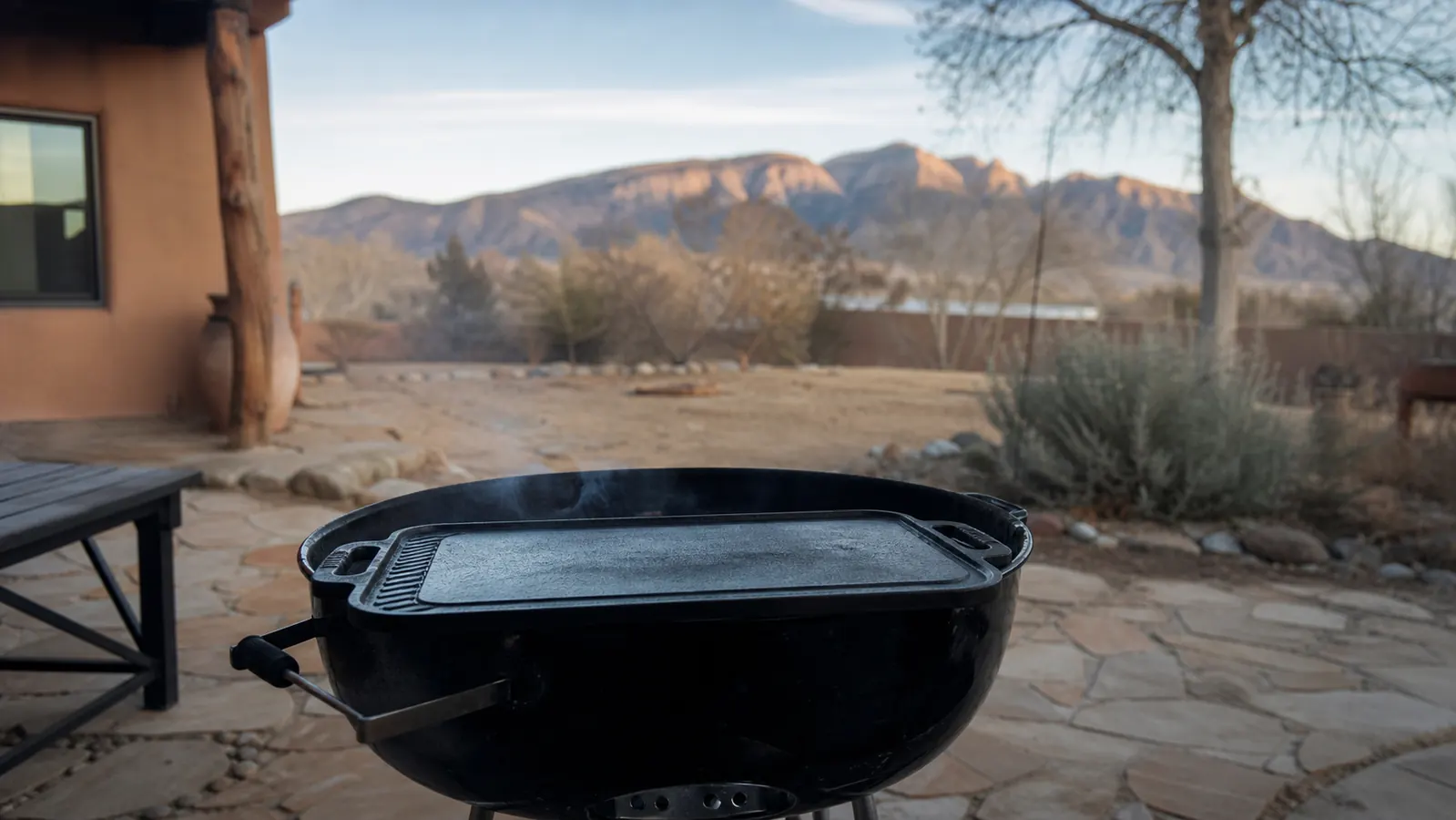
I picked up the Lodge reversible cast iron grill and griddle pan in March of last year, mostly on a whim, because I wanted a flat surface I could set right across the grates of my Weber kettle and cook eggs and smash burgers without watching food fall through the grid every time I flipped something small. It is a plain, honest slab of iron, 16.75 inches by 9.5 inches, ridged grill lines pressed into one face and a smooth flat face on the other, and it has lived on my grill cart or riding on top of the kettle for roughly fourteen months now. This is not a first-week impression. It is what a Lodge griddle looks like after somewhere around a hundred and ten cooks at 5,000 feet, through two New Mexico summers of dust and one winter I kept grilling through longer than I probably should have, including a few nights below freezing where I stood out there in a coat just to get bacon going.
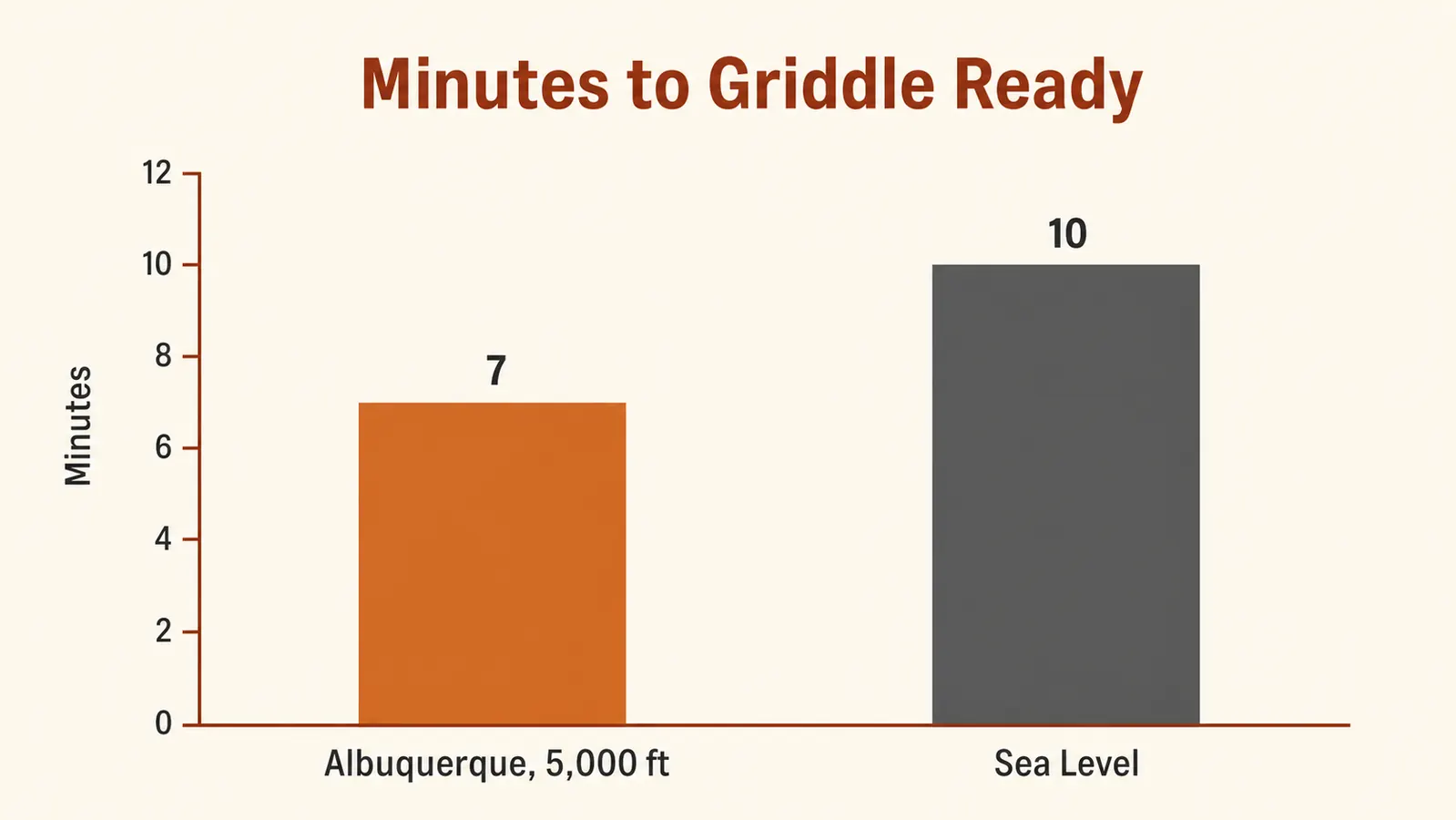
Cast iron behaves a little differently up here than it does at sea level, same as everything else on my patio. Thin, dry air means my charcoal catches hotter and faster than it would in Houston or Dallas, and that means this Lodge griddle heats up quicker than most flat-top guides assume, usually about seven minutes to a shimmer set over a full chimney of lit briquettes, instead of the ten minutes most instructions written at sea level tell you to expect. Cast iron holds heat, it does not create it, and if you are not watching how fast the pan climbs at altitude you will scorch a batch of eggs before you realize what happened. I learned that the hard way twice in my first two weeks owning it, and I have not burned a breakfast on this griddle since. These days I set a kitchen timer the moment the pan goes on, out of habit more than necessity, because that early lesson stuck.
The Quick Verdict
After fourteen months riding on top of my kettle grill, the Lodge reversible griddle has held its seasoning well, cooks evenly enough for smash burgers and pancakes alike, and shows the kind of wear I would expect from honest, unglazed cast iron. The handles heat up faster than I would like, and the pan is heavier than it looks in photos.
Amazon Check Today's Price →Tired of Losing Eggs and Bacon Through the Grates?
This is the same Lodge reversible grill and griddle pan I have been setting across my kettle for over a year, ridged side for sears, flat side for breakfast. It solves the exact problem of small food falling through open grill grates.
Amazon Check Today's Price on Amazon →How I've Used It, Season After Season
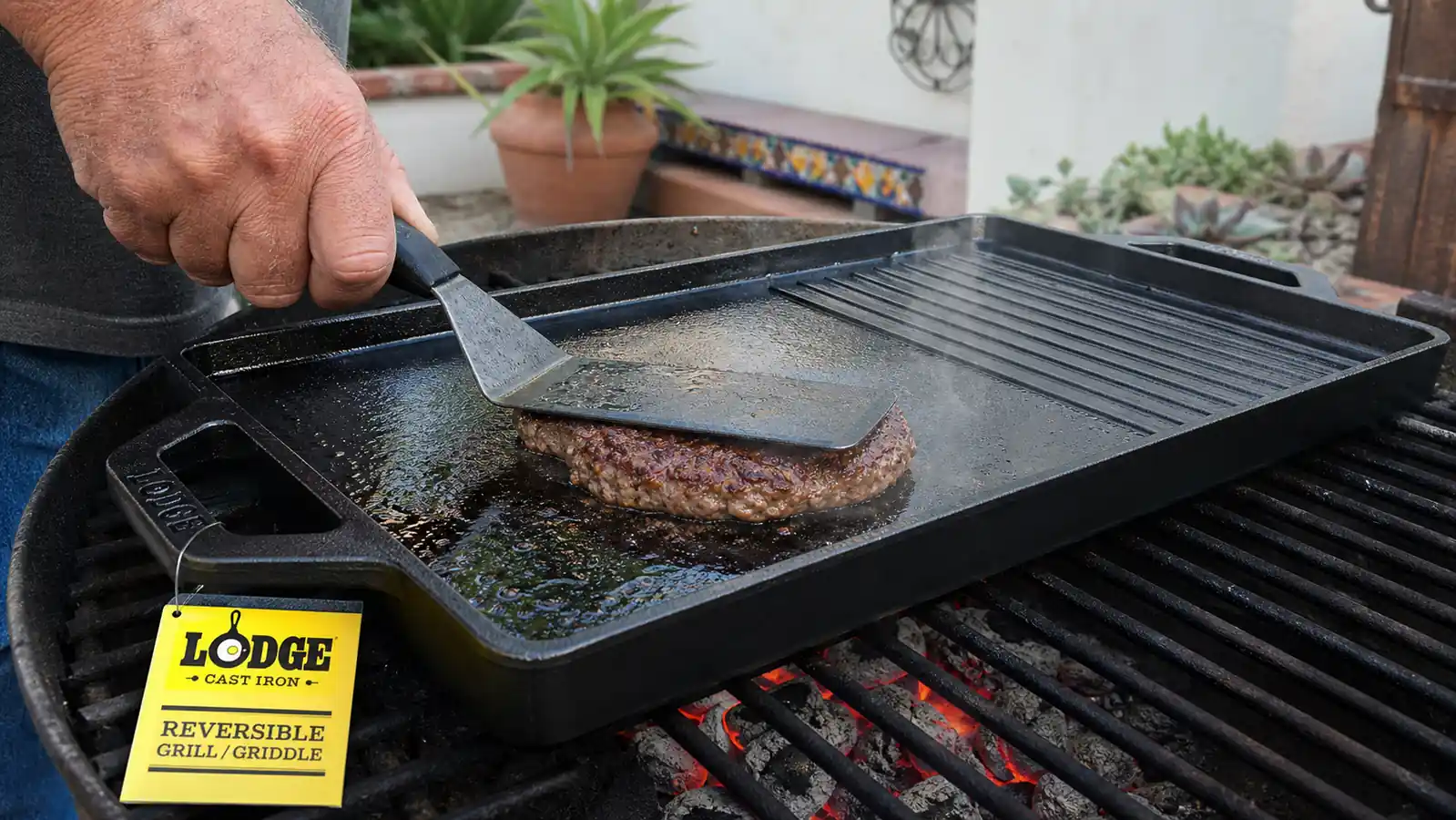
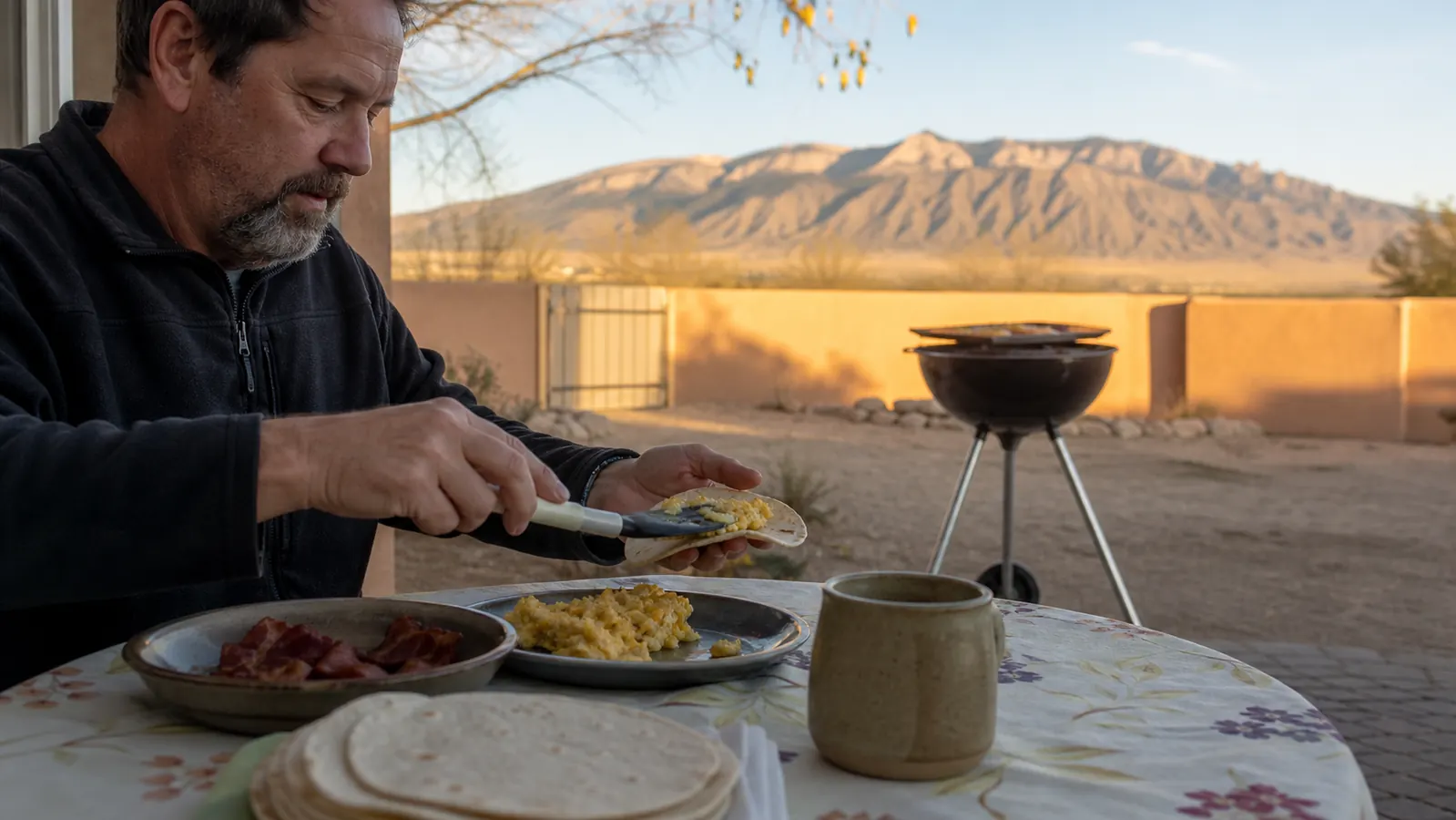
This griddle earns its spot on the grill cart most weeks. Weekday mornings when I want eggs and bacon without dirtying the kitchen stove, I set the Lodge griddle flat side up across the kettle's grates over a small pile of lit lump charcoal, let it come up to temperature for those seven minutes or so, and I have breakfast for two done in under fifteen. Weekend cooks lean harder on it. Smash burgers are the single thing I make on it most, four-ounce balls of ground chuck pressed thin with a metal spatula the second they hit the hot iron, and the flat side holds heat evenly enough that I can run four patties at once without the third one lagging behind the first. I keep a squeeze bottle of beef tallow and a small tub of chopped green chile within arm's reach for exactly that reason, since the window to press and season a smash burger is short and I do not want to be hunting for ingredients mid-cook.
The Fourth of July cookout last summer is the cook I keep coming back to when people ask if this thing is worth owning. I ran nineteen smash burgers off that one griddle over about ninety minutes, wiping it down with a paper towel and a fresh scrape of tallow between batches, and it never lost its crust or its heat the whole afternoon. That is the kind of volume test a two-week product trial never shows you, and it is where a solid, heavy piece of Lodge cast iron separates itself from a thinner stamped-steel flat top that would have warped or cooled off halfway through. By the time the last batch came off, the griddle had actually built up an even better crust than it started with, dark and glassy in the middle where the fat had rendered in over and over.
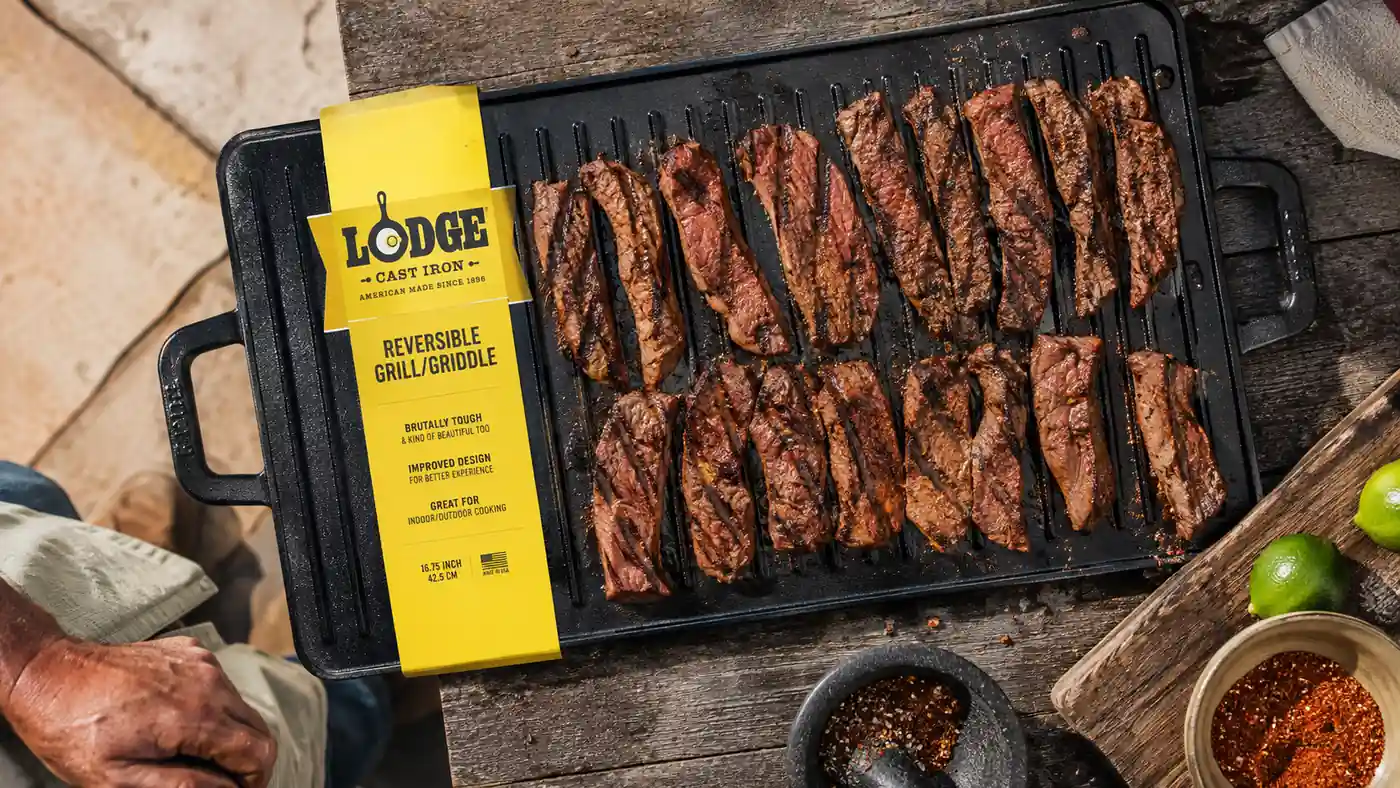
I flip it to the ridged side less often, mostly for skirt steak, bell peppers, or the occasional batch of quesadillas when I want grill marks instead of an even sear. The ridges are shallow compared to a dedicated cast iron grill pan I owned years back, which means they mark food nicely without trapping so much fat that everything ends up half-fried instead of grilled. Between the two faces, I would guess the flat side gets used about three times as often as the ridged side in my kitchen, which is worth knowing if you are deciding whether the reversible design is a real feature or just a selling point. Green chile strips get the ridged treatment most often in my house, roasted right alongside whatever meat is going, and the char those ridges leave behind is close enough to a comal that I have mostly stopped roasting chile any other way.
Seasoning and Rust After Fourteen New Mexico Months
The pan came pre-seasoned from Lodge, and that factory coat was thin but functional right out of the box, enough to fry an egg without much sticking after a light coat of oil. It took maybe a dozen cooks before the surface built up the deep, dark patina I actually trust, and by month three it had a shine close to a well-used skillet, food releasing clean without a fight. The dry Albuquerque air has been kind to it in one specific way, rust has never been a real problem for me, since I am not fighting the kind of humidity that plagues cast iron owners in the Gulf states. I dry it on residual heat after every wash and rub in a thin coat of oil while it is still warm, and that has been enough. A neighbor of mine who spends summers on the Texas coast tells me his own Lodge pans need re-seasoning twice a year just to keep ahead of the humidity, something I have never had to do with mine.
I did let it sit wet in the sink once, around month six, after a rushed cleanup before company showed up, and found a faint patch of orange rust the next morning near one handle. A few minutes with steel wool and a re-oiling fixed it completely, no lasting damage, but it was a reminder that cast iron does not forgive shortcuts even in a dry climate. If you live somewhere more humid than the high desert, I would expect that kind of slip to cost you more than a few minutes of scrubbing.
Heat Retention and Hot Spots on Top of a Kettle
Running this Lodge griddle over an open charcoal fire instead of a flat stovetop burner introduces a wrinkle most reviews skip over entirely. Charcoal heat is not perfectly even, and cast iron is a good enough conductor that it will show you exactly where your coal bed is thin. I get a noticeably hotter zone directly above where I bank my coals, usually the back third of the griddle when I set it up for a burger run, and I have learned to rotate patties toward that zone late in the cook rather than plant everything in one spot from the start.
At 5,000 feet, that unevenness shows up faster than it would at sea level, because the thinner air means the fire itself burns hotter and less predictably without me actively managing the vents. A gust off the mesa can shift my coal bed's heat output by what feels like fifty degrees in under a minute, and a heavy piece of cast iron like this one buys me a real buffer against that, since it does not spike and dip the way a thin steel griddle would in the same wind. That thermal mass is honestly the single best argument for cast iron over steel if you are cooking on an open kettle instead of a dedicated flat-top grill with a sealed burner underneath it. I have run an infrared thermometer across the surface mid-cook a few times just out of curiosity, and I have seen swings of forty degrees between the hottest and coolest corners on a windy afternoon, which is worth knowing before you assume every square inch is cooking the same.
What I Looked at Before Buying, and What I'd Consider Now
Before I bought the Lodge, I looked at a couple of cheaper off-brand cast iron griddles at the hardware store in town, both noticeably thinner and lighter in the hand, and a steel plancha insert a neighbor swore by for his gas grill. The off-brand griddles felt like they would warp under the kind of heat swings I put gear through, and the steel plancha, while lighter and faster to heat, does not hold temperature nearly as long once you pull it off direct fire, which matters when I am plating four burgers in sequence instead of all at once. I landed on the Lodge mainly because it was a known quantity, a brand I already trusted from my Dutch oven, and the reversible design meant one purchase covered both a griddle and a grill pan instead of needing to buy each separately.
If I were buying today, I would still land on this same Lodge griddle for anyone running a kettle or a basic charcoal grill without a built-in flat-top zone. I have thought about upgrading to one of the larger steel flat tops that bolts onto a dedicated cart, and for someone who cooks for a crowd every weekend, that upgrade probably makes sense. For my own patio, where most cooks are for two to four people on a weeknight, the size and weight of this Lodge piece has been the right fit, and the current price is a fraction of what a dedicated flat-top grill setup would run.
What I Liked
- Heavy cast iron holds steady heat through wind gusts that would rattle a thinner steel griddle
- Reversible design covers both flat griddle cooking and ridged grill marks in one piece
- Dry high-desert air has kept rust to a single minor incident in fourteen months
- Handles evenly across four smash burgers at once without cool spots dragging behind
- Fits directly across a standard kettle grill's grates with no extra hardware needed
Where It Falls Short
- Handles heat up fast over open coals and need a thick towel or glove, no stay-cool grip
- Heavier than it looks in photos, awkward to lift one-handed off a hot grill
- Uneven charcoal heat under an open kettle creates a real hot zone you have to manage manually
- Factory seasoning is thin and needs a dozen or so cooks before it performs like a well-used pan
- Flat side gets used far more than the ridged side, so the reversible feature may be underused for some cooks
Fourteen months and roughly a hundred and ten cooks in, the only real damage this griddle has taken is a rust patch I caused myself by leaving it wet in the sink for one night. That's a track record most kitchen cookware never gets tested against.
Who This Is For
This is for anyone who already owns a kettle or basic charcoal grill and wants to cook smash burgers, eggs, bacon, or seared vegetables without those small foods falling through open grates. It is a strong fit if you cook for two to four people on a regular basis rather than hosting a large crowd every weekend, since the size handles that volume comfortably without taking over the whole grill surface. It is also a good match for anyone in dry, windy conditions like mine, where the thermal mass of real cast iron buys you a buffer that a thinner flat top just cannot match, and for anyone who already owns other Lodge pieces and wants the seasoning routine to feel familiar instead of learning a new material from scratch.
Who Should Skip It
If you regularly cook for a crowd of eight or more, a dedicated flat-top grill with a larger cooking surface and built-in burner control will serve you better than a single 16.75 by 9.5 inch griddle riding on a kettle. Skip it too if you are not willing to dry and oil cast iron after every use, since this pan will rust with any real neglect even in a forgiving climate. And if hauling a heavy iron slab on and off a hot grill sounds like more hassle than it is worth, a lighter aluminum or steel griddle insert will be easier on your hands, even if it does not hold heat nearly as well over an open fire.
Fourteen Months, One Griddle, Still on the Cart
That's the actual track record on my Lodge reversible grill and griddle pan. If you're tired of small food falling through open grates, this is the one I'd point you toward.
Amazon Check Today's Price on Amazon →